
20 Employee Engagement Statistics You Need to Know

What do the latest employee engagement statistics actually tell us about what's driving disengagement in 2026?
Employee engagement statistics reveal that the problem is both measurable and solvable — but only 21% of employees globally are engaged, and the ratio of engaged to actively disengaged workers in the US hit an 11-year low this year.
Why should these numbers matter beyond the HR department?
Disengaged teams deliver measurably worse business outcomes across profitability, absenteeism, safety, and customer satisfaction — making engagement data a strategic finance conversation, not just a culture one.
How can HR leaders translate these statistics into action their organizations will actually fund?
This guide breaks down 20 key data points by category — recognition, management, work arrangement, generation, and communication — and connects each one to specific interventions you can prioritize immediately.
What Is Employee Engagement?
Employee engagement is the emotional commitment employees have to their organization, their work, and their colleagues. It is not the same as employee satisfaction or job satisfaction. Satisfaction reflects how content someone feels in a role. Engagement reflects how much they care about outcomes and how willingly they contribute beyond what is required. Understanding this distinction between engagement and satisfaction is critical for building effective employee engagement strategies.
For senior HR leaders focused on talent optimization and workforce resilience, these statistics provide the evidence base needed to make a strategic case for investment in engagement infrastructure and employee experience initiatives.
Key Takeaways
- Engagement is emotional commitment, not satisfaction. Satisfied employees do what's asked; engaged employees go further.
- Managers drive 70% of the variance in team engagement, making manager enablement the highest-leverage fix available to HR. See HR Cloud's performance management tools.
- Frontline and deskless workers report the lowest engagement because most platforms weren't built for them. Mobile-first delivery closes the gap — that's what Workmates is designed for.
- Annual surveys create a 3–6 month blind spot. Continuous listening through pulse surveys catches disengagement before it becomes turnover.
- Recognition is the cheapest engagement lever. Employees recognized weekly are 2.7x more likely to be highly engaged.
- Onboarding sets the engagement ceiling. 43% of new hires leave in the first 90 days — most engagement problems start as onboarding problems.
The State of Global Employee Engagement in 2026
According to the latest Gallup report, 62% of employees globally are not engaged, and 17% are actively disengaged. Actively disengaged means feeling miserable at work and actively spreading negativity to colleagues. This represents a significant challenge for workplace engagement and workplace culture. The ratio of engaged to actively disengaged employees in the US fell to 1.8-to-1 in 2026, down from 2.1-to-1 in 2025. That narrowing ratio signals a workforce moving in the wrong direction, highlighting the urgent need to improve employee engagement.
To understand what these engagement levels mean for your teams and what intervention each group needs, read HR Cloud's guide to employee engagement levels.
More statistics should motivate you to focus more on employee engagement and move you in the right direction. Let's dive in.
How Disengagement Hurts Your Business
Highly engaged employees are less likely to look elsewhere for work, which drives higher employee retention rates. But the absenteeism data is where the numbers get particularly sharp.
From wages to work culture, one of the primary reasons behind employee absenteeism is disengagement. Employees who are disengaged at work often struggle with low employee engagement and poor employee morale. Gallup data shows that top-quartile engagement teams experience 81% lower absenteeism than bottom-quartile teams. A stable, present workforce does not happen by accident. It is the result of deliberate engagement investment and employee engagement initiatives designed to boost employee engagement.
Employee engagement is broader than keeping employees happy. It is about motivating, assisting, encouraging, and giving people direction through effective employee engagement programs. You can start with two important areas: work-life balance and employee recognition.
For teams that need help spotting disengagement patterns early, Workmates by HR Cloud tracks participation in recognition programs, communication channels, and employee surveys — so managers can act before absenteeism and turnover follow.
What Highly Engaged Teams Deliver: The Business Case
Highly engaged teams consistently outperform disengaged ones across every major business metric. High employee engagement drives measurable results across the organization.Gallup's research across thousands of business units shows median differences between top-quartile and bottom-quartile engagement units:
- 23% higher profitability
- 18% higher productivity in sales roles
- 10% higher customer ratings
- 81% lower absenteeism
- 59% lower turnover in high-turnover industries
- 70% fewer safety incidents
You are likely to see measurable increases in sales, profitability, and customer ratings when engagement goes up. These are not marginal gains. They compound across your entire workforce, demonstrating why best employee engagement practices and engagement metrics matter for business success.
Recognition and Employee Engagement: The Data
A study on top performance motivators found that 37% of employees feel most encouraged by personal recognition and employee appreciation. A recent employee engagement and modern workplace report showed that 84% of highly engaged employees received recognition the last time they went the extra mile at work. Not surprisingly, only 25% of actively disengaged employees were recognized for a job well done.
Recognition represents more than feel-good gestures. It is a fundamental human need in professional settings and a cornerstone of employee motivation. When employees receive acknowledgment for their contributions through rewards and recognition programs, several things happen: their sense of purpose increases, they feel validated that their work matters, and their commitment to the organization strengthens.
Employees who receive recognition at least once a week are 2.7 times more likely to be highly engaged.
About 90% of workers say they work more dedicatedly once they are recognized for their efforts, demonstrating the power of a strong recognition culture.
HR Cloud's employee recognition platform makes peer-to-peer recognition, points-based rewards, and milestone celebrations part of the daily flow of work — not an afterthought. Customers like Mizkan reported a 20% increase in employee engagement and a 65% participation rate after implementation. (HR Cloud Mizkan Case Study)

The Manager Effect: 70% of Engagement Variance Explained
Managers dictate 70% of the variance in team-level employee engagement. This single Gallup finding should reshape how your organization allocates its manager development budget and improve team engagement strategies.
What makes it more urgent right now: manager engagement itself is falling. Gallup's 2026 data shows manager engagement dropped from 30% to 27%, with the steepest declines among managers under 35 and female managers. Organizations running employee engagement programs without addressing manager enablement and coaching conversations will plateau. The two cannot be treated separately. Effective team dynamics depend on managers who understand how to foster employee engagement.
According to a recent Gartner poll, only 16% of companies leverage technology to track employee progress and engagement. Despite overwhelming evidence that engaged workforces outperform competitors, most organizations still rely on annual surveys or informal manager observations. That creates a 3–6 month blind spot between when a problem develops and when leadership finds out about it.
HR Cloud's performance management tools give managers structured frameworks for 1:1s, goal tracking, and real-time recognition — the three behaviors most consistently linked to high team engagement and keeping employees engaged.
Employee Engagement by Work Arrangement
Engagement patterns differ significantly based on where employees work. According to Gallup's 2026 research on remote work and hybrid work arrangements:
- Hybrid employees: 34% engaged (highest of any arrangement)
- Fully remote employees: 30% engaged
- Fully on-site employees: 28% engaged
Hybrid workers report the highest engagement largely because they preserve social connection while maintaining flexibility through flexible work arrangements. The challenge is that frontline and deskless employees — who represent the majority of workforces in healthcare, manufacturing, construction, and retail — are predominantly on-site and consistently report the lowest engagement levels.
Reaching these employees requires mobile-first tools. Most traditional engagement platforms are built for knowledge workers with desks and laptops. HR Cloud's mobile app is purpose-built for frontline and deskless teams, allowing recognition, announcements, and pulse surveys to reach every employee — regardless of whether they have a corporate email address or a desk.
Employee Engagement by Generation
Gallup's 2026 data shows Gen Z and younger Millennial workers (under 35) experienced the sharpest engagement declines in 2026, falling five percentage points year over year. This group reports the lowest scores on:
- Clarity of expectations from their managers
- Frequency of recognition they receive
- Opportunities to do work they are good at
For HR leaders managing multigenerational workforces, this means a single engagement approach will consistently miss younger employees. They need more frequent check-ins through employee feedback mechanisms, clearer role expectations, and visible career growth paths supported by professional development and mentorship programs. Without these, they disengage — and with more job market options than previous generations, they leave.
The Workmates platform supports customizable employee engagement activities by team, role, and location. You can tailor recognition frequency, communication channels, and feedback cadence to what each group actually responds to, creating employee engagement examples that resonate with different demographics.
Communication, Technology, and the 16% Gap
When managers share company news and relevant information regularly, employees feel motivated to work toward the mission, vision, and goals. When employees understand how corporate decisions affect them, transparency builds trust through effective feedback loops. And trust is a prerequisite for engagement and a strong company culture.
According to a recent Gartner poll, only 16% of companies leverage an employee engagement tool to track employee progress and engagement. The companies that invest in structured communication and measuring employee engagement show dramatically better outcomes. Organizations that follow engagement best practices consistently report 70% average engagement rates, compared to the 21% global average. That is not a marginal difference — it is the difference between a thriving culture and a retention crisis.
Share information regularly to increase employee knowledge and build employee engagement. Use internal communication tools to empower teams to collaborate and build a learning-focused culture. Organizations that implement structured communication calendars — rather than ad-hoc updates — see 28% higher information retention and 41% better strategic alignment. Create a communication calendar that ensures regular cadence without overwhelming employees. Use company announcement features for critical updates that require acknowledgment tracking and strengthen the employee voice.
HR Cloud's employee engagement survey tools let you move from annual surveys to continuous listening — capturing real-time sentiment and employee insights before small issues become expensive problems. This approach to measuring staff engagement and measuring engagement overall provides the data needed for effective employee engagement solutions.
Work-Life Balance and Engagement
The data on work-life balance and engagement is consistent across sources:
- 33% of employees express being "very satisfied" with their paid time off benefit — according to SHRM's report
- Employees who take a break every 90 minutes report a 30% higher level of focus
- 90% of leaders think an engagement strategy has an impact on business success, but barely 25% of them have a strategy — as stated by Muse
- According to one survey, the majority of employees change their jobs because of boredom. Lack of challenge drains motivation and makes employees feel their skills are wasted.
- 3 in 5 HR leaders believe the HR function will rapidly become irrelevant if it does not modernize its approach to understanding and planning for the future needs of the workforce — KPMG source
Work-life balance is not a soft concern. It is one of the two most direct levers HR leaders have to increase employee engagement and support mental health support initiatives. The majority of employees will not skip work if there is no compromise on personal life and career. Recognizing effort through employee development and learning and development opportunities serves as a powerful motivator alongside balance.
HR Cloud's Time Off tracking helps HR teams monitor PTO usage patterns, flag employees with unused leave who may be building toward burnout, and ensure work-life policies are actually functioning — not just stated. This supports sustaining employee engagement over the long term.
Reduced Absenteeism Through Engagement
There is an 81% decrease in employee absenteeism with an increase in employee engagement. (Gallup)
Disengaged employees sometimes call in sick not due to physical illness but because they need mental respite from unrewarding work environments. Engaged employees take accountability for their responsibilities and feel genuine concern about work left undone. That internal sense of organizational commitment drives attendance — not fear of consequences.
This particular statistic is really significant for engagement and retention. When you work on engagement, you are not just building a better culture. You are building a more reliable, stable workforce.
Learning, Development, and Engagement
According to Harvard Business Review, 71% of executives believe it is a high level of employee engagement that sets their organizations apart from competitors. The most engaged workforces share a common thread: they invest in their people's growth through professional development, team building, and employee resource groups.
- 94% of employees say they would stay longer at a company that invests in their career development (LinkedIn Workplace Learning Report)
- Organizations that offer inadequate onboarding programs have twice the chance of facing employee turnover in the first 90 days
- 43% of new hires leave their jobs in the first 90 days because the role described during hiring did not match what they experienced on day one
The connection between onboarding and new employee engagement is direct. The first impression shapes every subsequent engagement decision an employee makes. A structured, consistent onboarding experience tells new hires they made the right choice and aligns them with company values. A disorganized one plants the seed of doubt that compounds over months, affecting both engagement and satisfaction.
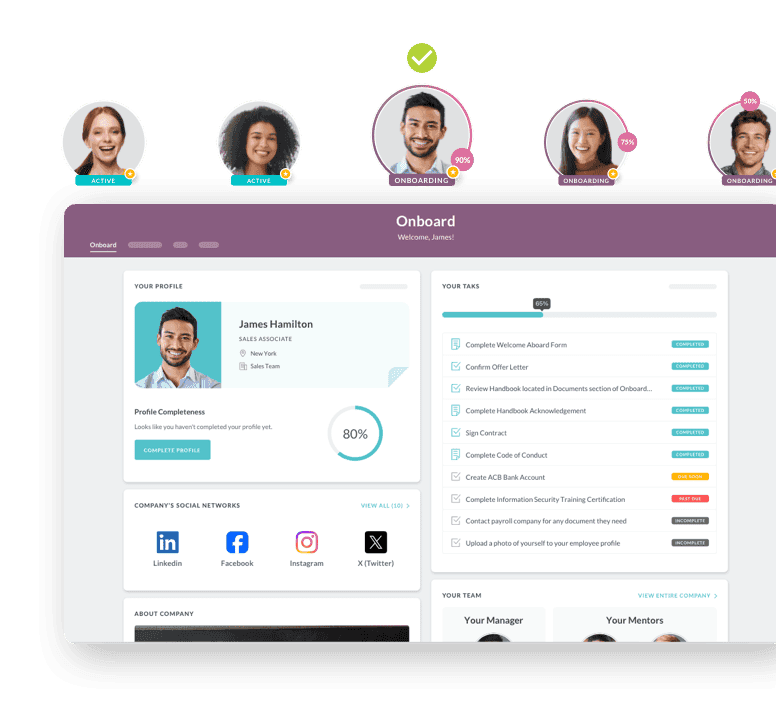
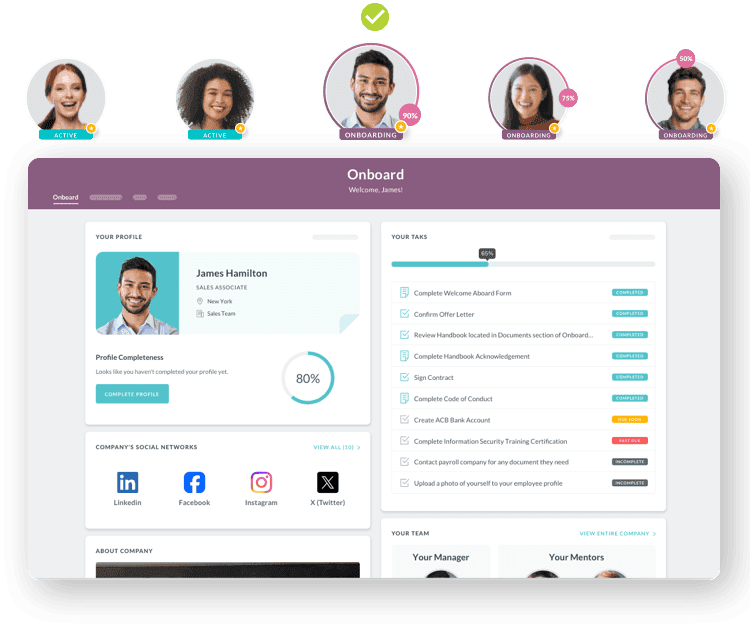
HR Cloud's employee onboarding software automates onboarding workflows, digitizes paperwork, and gives new hires a clear, welcoming experience from day one — before disengagement has a chance to take root. This supports internal mobility and creates pathways for career growth.
How to Use These Statistics to Drive Action
Consider employee engagement software that includes pulse surveys, recognition tracking, and participation analytics to systematically monitor team wellbeing. Start with quarterly employee engagement surveys, then layer in recognition tracking, communication analytics, and performance metrics as your employee engagement strategies matures.
Traditional annual engagement surveys create several predictable problems:
- Delayed response: By the time survey results are compiled and acted upon (typically 3–6 months after administration), the problems employees identified have often worsened.
- Lack of continuity: Annual surveys provide single snapshots without tracking progress. Employees cannot see whether their feedback drove any changes.
- Survey fatigue: Comprehensive annual surveys often exceed 50–100 questions, requiring 20–30 minutes to complete. Quality drops as employees rush through.
- Limited specificity: Annual surveys must cover all topics broadly, preventing deep dives into specific issues affecting particular teams.
The more effective approach is continuous listening: short pulse surveys, real-time recognition tracking, and regular manager check-ins that surface issues while they are still solvable. This approach to measuring employee engagement and staff engagement provides actionable data.
Many organizations find value in frameworks like the Gallup Q12 or the Gallup Q12 methodology for employee engagement questions that drive meaningful insights. These employee engagement metrics help identify specific areas for improvement and track progress over time.
Hopefully, these statistics have inspired you to focus more on engaging your workforce — because that means improving your entire organization's performance. Start implementing employee engagement ideas and employee engagement activities today through effective employee engagement initiatives, and you will boost employee morale and your company's profitability before you know it. Consider volunteer programs, social impact initiatives, and performance incentives as part of your comprehensive approach to foster employee engagement.
Ready to Act on These Numbers?
Most HR leaders know employee engagement important for organizational success. Fewer have the systems to measure it continuously, recognize employees in real time, and reach every worker regardless of role or location.
Workmates by HR Cloud brings together pulse surveys, peer recognition, internal communication, and analytics in one platform. Most organizations are live within four days — with no setup fees and implementation included.
Book a free demo and see how teams like yours move from engagement data to measurable results.

Experience how Workmates can transform communication and strengthen culture—all in one powerful platform
Book Your Free DemoFrequently Asked Questions
Q1: What percentage of employees are engaged at work globally?
Only 21% of employees worldwide report being engaged at work, per Gallup's 2026 State of the Global Workplace report. In the US, the engagement rate sits at 31%, an 11-year low. The remaining workforce is split between those who are "not engaged" (going through the motions) and the 17% who are "actively disengaged" — employees who actively undermine team performance and morale. For organizations trying to close this gap, HR Cloud's Workmates platform offers pulse surveys, peer recognition, and behavioral analytics to track and improve employee engagement continuously.
Q2: What is the cost of employee disengagement?
Disengaged and not-engaged employees cost the global economy $8.8 trillion annually in lost productivity, according to employee engagement research from Gallup. At the organizational level, disengagement drives higher absenteeism — Gallup data shows top-quartile engagement teams experience 81% lower absenteeism than bottom-quartile teams — along with increased voluntary turnover, reduced customer satisfaction, and more safety incidents. HR Cloud's Workmates tracks participation in recognition programs and employee survey responses so managers can identify disengagement early, before it compounds into turnover.
Q3: How much does manager quality affect employee engagement?
Gallup research shows managers account for 70% of the variance in team-level engagement. Manager behaviors — recognition frequency, clarity of expectations, and the quality of regular 1:1 conversations — are the most controllable engagement driver available to any organization. In 2026, manager engagement itself dropped from 30% to 27%, with the steepest declines among managers under 35. HR Cloud's performance management tools give managers structured frameworks for goal tracking, 1:1 documentation, performance reviews, and real-time recognition — the three behaviors most directly tied to team engagement scores.
Q4: What causes employee disengagement?
The primary drivers of disengagement are lack of recognition, poor manager relationships, unclear role expectations, no career development opportunities, and ineffective internal communication. Gallup data shows employees who do not feel seen, valued, or challenged are most likely to disengage — and the slide from "not engaged" to "actively disengaged" happens gradually, making early detection critical. HR Cloud's Workmates platform combines pulse surveys, recognition tracking, and manager alerts to catch disengagement signals before they become turnover events, providing employee engagement solutions that work.
Q5: How often should employee engagement be measured?
Annual surveys are not sufficient for effective employee engagement measurement. Organizations relying on annual engagement surveys face a 3–6 month lag between identifying problems and taking action — by which point issues have compounded. Continuous measurement through monthly or quarterly pulse surveys, combined with behavioral signals like recognition participation rates and absenteeism trends, gives HR teams real-time data to act before turnover follows. HR Cloud's Workmates includes built-in pulse surveys and engagement analytics that surface team-level signals as they happen, not six months after the fact.
Q6: What is the difference between employee engagement and job satisfaction?
Employee engagement and job satisfaction are not the same thing, though many employee satisfaction programs confuse the two. Job satisfaction measures how content an employee feels about their role, pay, or working conditions. Employee engagement measures emotional commitment to the organization's goals and the discretionary effort an employee chooses to give. Satisfied employees may feel fine about their job but contribute only what is required. Engaged employees go further. Gallup's research consistently shows that high engagement — not high satisfaction — drives the 23% profitability gains and 81% lower absenteeism seen in top-quartile organizations.
Q7: Which industries have the lowest employee engagement?
Frontline-heavy industries — manufacturing, healthcare, construction, and retail — consistently report the lowest employee engagement rates. This is partly an infrastructure problem: most engagement platforms are built for desk-based employees and do not reach frontline or deskless workers effectively. HR Cloud's Workmates mobile app is built specifically for frontline teams, delivering recognition, company announcements, and pulse surveys to every employee regardless of whether they have a corporate email address or a laptop. Organizations in these sectors typically see engagement improvements within the first 90 days of deployment.
Author:
Angela White is an ed-tech enthusiast with a passion for writing for the consumer market in the areas of product research and marketing using quizzes and surveys. Having a knack for writing and an editorial mindset, she is an expert researcher at a brand that's known for creating delightfully smart tools such as ProProfs Quiz Maker.
Keep Reading


Like What You Hear?
We’d love to chat with you more about how HR Cloud® can support your business’s HR needs.
Book Your Free Demo